
Public and Agency Engagement
This appendix describes what public engagement means in the context of a corridor plan and includes guidance for conducting engagement activities throughout each step of the corridor plan process. This section does not cover every topic or issue that may arise, but it does provide a framework that can help guide the thought process. In 2021, MnDOT published the Public Engagement Planning Handbook which includes additional detail on how to plan and execute engagement activities.
This section is divided into three main parts:
- Public Engagement
- Preparing an Engagement Plan
- Partner Agency Engagement
MnDOT is committed to engaging the public and agency partners in its issues-identification and decision-making processes, including corridor planning, for several reasons:
- Progress toward common goals: Engagement early and often informs MnDOT decisions to best meet agency goals
- Risk mitigation: Problems and issues that require mitigation will emerge
- Shared decision making: Collective problem-solving takes advantage of the unique and creative insights of everyone involved
- Transparency and trust: Engagement increases trust in MnDOT, which leads to stronger policies and support
- Support for implementation: Decisions made when the public are engaged are likely to be more implementable and sustainable
- Shared ownership: Involved stakeholders and community members have more ownership of solutions developed
Public engagement is a critical component of corridor planning because it creates an opportunity for community members to help shape the future of the corridor. Effective public engagement means the outcomes of a plan will not only address the technical and physical constraints of a corridor but also reflect the vision, values, and lived experiences and local knowledge of the people who use it the most.
Public engagement should be used to inform a corridor plan at all five steps of the corridor planning process. The project team needs community members to weigh in on the local vision for the corridor, important issues and opportunities to be addressed, local priorities for design tradeoffs, and much more. Table B-1 below shows sample engagement outcomes, messages, questions, and tactics by corridor plan phase. This table is oriented toward public engagement, but similar outcomes, messages, and tactics should be detailed for partner agency engagement (see Partner Agency Engagement section). To be effective, this information should be defined in the community engagement plan. Use this table as a template or starting point for your engagement plan.
Table B-1. Engagement Activities, Questions and Tactics
Guidebook Steps |
Engagement Activities |
Sample Questions |
Potential Tactics |
Step 1. |
|
|
|
Step 2. |
|
General Questions
Topic-Specific Questions
|
|
Step 3. |
|||
Step 4. |
|
|
|
Step 5. |
|
|
|
Definitions
The guidance in this section is framed by the following definitions.
- Open Decision Making. The Statewide Multimodal Transportation Plan (SMTP) articulates the Open Decision Making objective as making equitable transportation decisions through inclusive and collaborative processes that are supported by data and analysis.
- Public Engagement. According to the MnDOT Public Engagement Handbook (2021) the term “public” applies to any individual or group not necessarily associated with decision-making power or special interests but who may have an interest in the outcome of a decision. In this context, the term public can include residents, business representatives, property owners, community organizations, non-profits, and travelers, among others. Public engagement refers to the ways in which we inform, consult, involve, collaborate, and empower the public in the corridor plan decision making process.
- Community engagement, public involvement, and public participation are terms that are often used as synonyms for public engagement. For the purposes of this guidance, the term public engagement is used.
- Partner Agency Engagement. Partner agencies are the regional and local jurisdictions (e.g., owners, regulators, service providers, etc.) through which MnDOT highways pass. Partner agencies often have legal jurisdiction over important aspects of a corridor (e.g., land use, utilities, municipal consent, etc.) and may have financial responsibilities in the form of cost participation when it comes to implementing the strategies identified in a corridor plan. For these reasons, local jurisdictions should be an active partner in the corridor plan process. Example partner agencies include local municipalities (i.e., cities, counties, and townships), watershed districts, transit agencies, and municipal planning organizations. Tribal governments also may be project partners and involved either through formal government to government consultation or more informally, at their option.
Healthy Equitable Communities
Public engagement is a critical part of fostering healthy and equitable communities through the corridor planning process. Public engagement helps to identify traditionally underserved communities that may experience disparities in the way the transportation system impacts their health and well-being. Engaging these communities in meaningful ways will ensure that the corridor plan includes strategies to address the specific disparities they experience.
In addition, the Step 3: Existing and Future Conditions subject area guidance sections address Healthy Equitable Communities with respect to each topic from a combined quantitative and qualitative perspective. Summaries of responses or relevant themes are to be included in each subject area discussion in the Existing Conditions report and should be referred to during the engagement process.
Equitable Engagement
Principles
- Everyone affected by a decision has a right to be involved, and we strive to engage all people.
- Everyone has a valid opinion, and we respect and actively listen to people.
- We go where people are. We do not expect them to come to us.
- People engage, learn and receive information in many ways, so we use a variety of strategies and tactics.
- We seek out local knowledge and contacts (cultural, neighborhood and business) to collaborate and better serve our communities.
- We give and gather information in multiple ways to provide access for all people invested.
- We learn from our experiences and hold ourselves accountable to our goals.
Considerations
- Is the information accessible to everyone, from a cultural perspective and for those with different language needs or abilities?
- How is the team considering removal of barriers to participation (location, timing, childcare, language access, compensation for time)?
- How are those with the highest level of interest involved in the process? How can we be transparent in our communications and setting of expectations for their influence and role?
- What level of influence does the public have over the outcomes of the planning process? Which issues/topics are fixed and which are flexible?
An engagement plan should be developed early in the process, following Step 1 (Pre-Planning). The engagement plan will typically include target audiences, key messages and questions that link community engagement to the technical steps in the corridor planning framework, specific engagement tactics, roles and responsibilities, and key milestones. Staff should treat the plan as a living document and update it throughout the plan to reflect feedback, address new issues, and adjust tactics as needed.
The MnDOT Public Engagement Handbook (2021) provides guidance for prepare an engagement plan (see Figure B-1 below). The following is a summary of the engagement planning process as it relates to corridor studies. Refer to the MnDOT Public Engagement Policy and Guidance for additional details.
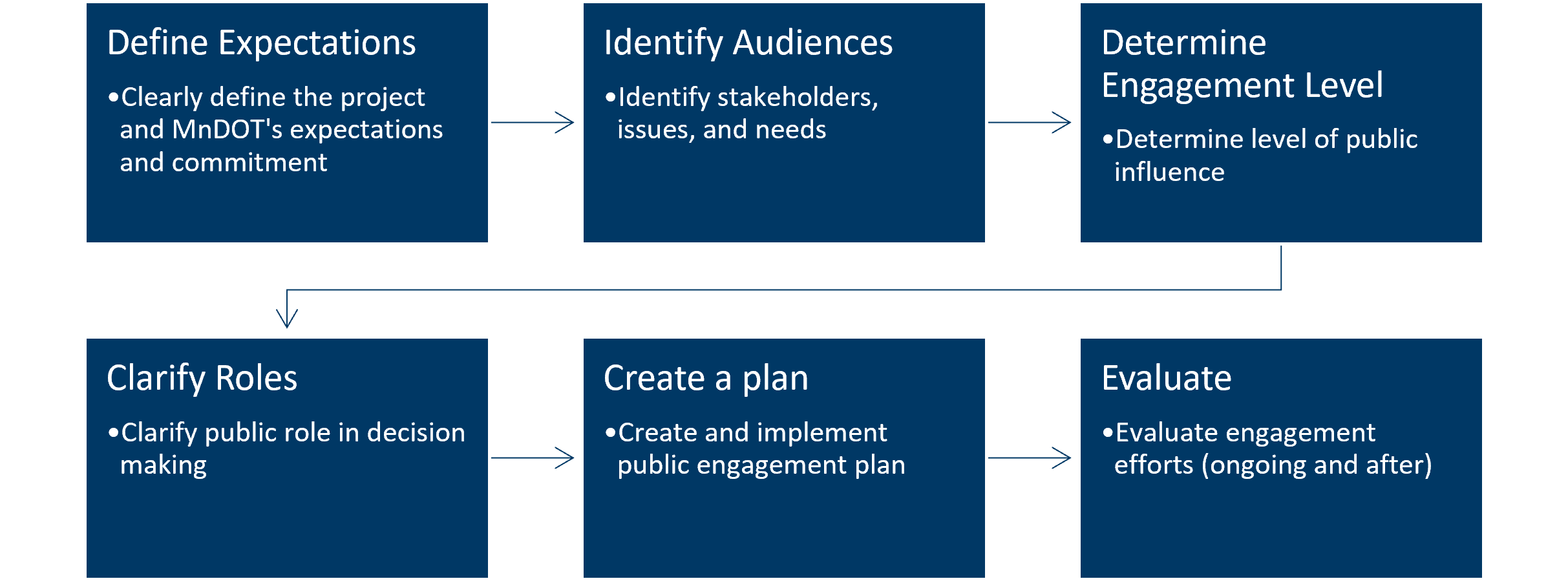
Figure B-1. MnDOT Public Engagement Planning Process
Step 1: Define Expectations
Start the public engagement planning by clearly defining the objectives of the corridor plan and key milestones. It is important to describe not only the problem or challenge from the agency’s perspective but also to listen to and include the public in identifying the problems or challenges as they see them in their community. The project team should be clear on the decisions that need to be made during the plan and how much influence the public can have on those decisions (i.e., understand internal expectations before managing external expectations).
Consultation meetings are a good strategy to help define plan expectations. Consultation meetings involve connecting with agency partners and key community segments early in the process, prior to developing the engagement plan. This can be done in informal phone call interviews or more formal listening sessions.
Step 2: Identify Target Audiences
A critical step in public engagement planning involves identifying target audiences for engagement. This will provide a better understanding of who might have an interest in the plan, help identify the issues people care about, and what needs they may have.
When identifying target audiences, think about the range of voices and perspectives that “should” be heard but may not show up at public meetings or open houses or otherwise engage with the project. Also think about who will be impacted and who could influence the outcome. The target audience analysis should be comprehensive enough to include the full range of interested and affected members of the public and agency partners. Consider plotting the positions and needs of these target audiences on a grid according to their level of interest in the plan and their level of influence. The MnDOT Public Engagement Handbook includes worksheets that can be used to help complete a target audience analysis.
 Step 3: Determine Level of Engagement
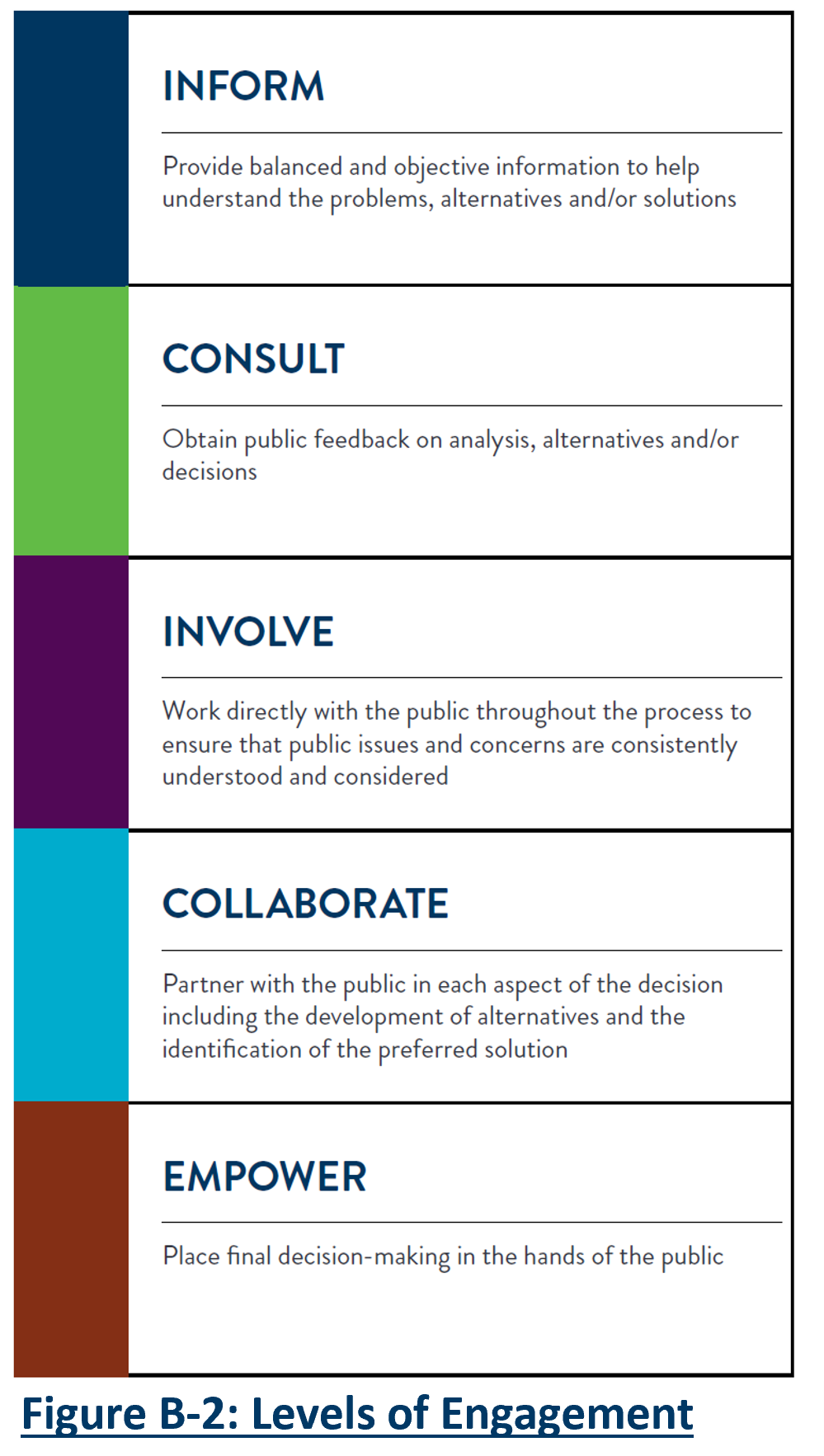
MnDOT’s commitment to public engagement means the agency will listen first and ultimately inform, consult, involve, collaborate and/or empower stakeholders and the public in transportation decision-making. Because the goals of engagement will vary from one phase of the project to the next, the activities and level of engagement will vary along the spectrum from Inform to Empower.
It is important to identify and communicate the level of influence community members will have over the decision-making process. The project team should answer questions such as what elements of the plan are fixed with no opportunity for public influence, and what elements are flexible and open to public input? Figure B-2 describes the levels of engagement, based on the Spectrum of Participation from the International Association for Public Participation (IAP2). Often, a corridor plan will include aspects of each of these levels of engagement depending on the topic being considered and stage of the plan. Most often consult and involve are used in corridor plans.
Step 4: Clarify Roles
As part of the process of developing an engagement plan, it is important to ensure that there is agreement with stakeholders and agency partners on the problem to be solved. If there isn’t agreement, determine how to address or facilitate a resolution of the problem identification before determining the public’s role in decision-making. Local jurisdictions and partner agencies should be considered in this step to ensure the project addresses not only MnDOT’s goals but also those of the project partners.
Step 5: Create the Engagement Plan
The engagement plan should document the results of steps one through four in a clear and concise document that can be shared publicly. The MnDOT Public Engagement webpage includes extensive guidance on creating engagement plans, including step-by-step process guidance and templates. At a minimum, the engagement plan should include the following:
- Project overview/description
- Identification of target audiences, such as residents, business representatives, property owners, community organizations, non-profits, travelers, etc.)
- Key messages and engagement questions by phase
- Specific engagement tactics
- Roles and responsibilities
- Schedule or timeline
Step 6: Evaluate and Close the Loop
Step 6 is the final step in the engagement planning process and includes both ongoing evaluation and closing the loop with the public and others. While it is part of the last step, evaluation should be ongoing and should occur at every stage throughout the process asking questions like “did we achieve what we set out to achieve?” and “what voices are missing from the process?” Evaluation efforts may be scaled with resources appropriate to the level of project and public engagement activity. It is also important to close the loop with internal and external audiences by summarizing what was learned during the engagement process, how the input informed the plan, and (if needed) explain how MnDOT was or was not able to use selected input.
Engagement Tactics: Additional Detail
Engagement tactics are specific actions used to both inform and collect input from community members and can include in-person meetings or events, virtual engagement tactics like surveys and interactive mapping, and communication tools such as flyers, yard signs, and mailers.
Public engagement tactics should be customized to meet the needs of specific audiences and should include a mix of virtual and in-person activities, grouped to coincide with the engagement phases, as described above. Engagement tactics should provide multiple opportunities for people to get involved in ways that are convenient for them.
Table B-2 includes summarizes common engagement tactics and activities and additional detail on how and when they might be applicable. The MnDOT Public Engagement Planning Handbook includes additional examples of common engagement tactics by engagement level.
Table B-2. Sample Engagement Tactics
In-person Engagement |
|
Pop-up events |
|
Listening session |
|
Community-based organization meetings |
|
Field walk/tour |
|
Council or board meetings/hearing |
|
Open house/Public Meeting |
|
Virtual Engagement |
|
Project website |
|
Online survey/interactive map |
|
Email updates/newsletter |
|
Social media |
|
Communications and Promotions |
|
Factsheet |
|
Post card/mailing |
|
Press release |
|
Yard sign/sidewalk decal/indoor display |
|
This section includes guidance for conducting engagement with partner agencies and tribal governments. Partner agencies include the local jurisdictions through which MnDOT highways pass or are adjacent to. Partners often have regulatory jurisdiction over important aspects of a corridor (e.g., land use, utilities, municipal consent, etc.) and may have financial responsibilities in the form of cost participation when it comes to implementing the strategies identified in a corridor plan. In addition, it is often necessary for MnDOT to coordinate investments with partner agencies for related improvements such as intersecting streets, aesthetic improvements, and curbside uses. For these reasons, local jurisdictions should be an active partner in the corridor plan process.
Planning for Partner Agency Engagement
The first step in engaging partner agencies is to identify the partner agencies and tribal governments that should be involved based on their level of ownership and interest in the corridor plan. Typical partner agencies include the following:
- Local municipalities (i.e., cities and townships) and counties
- Metropolitan planning organizations (MPOs)
- Regional development commissions/organizations (RDCs/RDOs)
- Watershed districts or management organizations
- Transit providers
- Tribal partners
It is important to work with partner agencies to determine their level of involvement and to define shared objectives for the corridor plan. MPOs have a unique role in corridor planning as agencies charged with leading continuous and ongoing planning within their regions. Engagement with these partners should include identification of how the roadway corridor relates to any regional transportation policies and plans.
Tools and Tactics
Partner agencies should be active participants throughout the plan process. Table B-3 shows common partner agency engagement tactics and a summary of their applicability.
Table B-3. Common Tools for Partner Agency Engagement
Tool |
Applicability |
Project Management Team meetings (PMT) |
|
Technical Advisory Committee meetings (TAC) |
|
Policy Advisory Committee meetings (PAC) |
|
Individual agency coordination meetings |
|
Elected official briefings |
|
Tribal governments and Tribal coordination |
|