
About Archaeological Predictive Modeling
- Academic Papers in Archaeological Predictive Modeling
- Archaeolgoical Predictive Modeling: Method and Theory (Madry, Cole, and Seibel, 2005)
- Causality and Cross-Purposes in Archaeological Predictive Modeling
- Commentary on Inductive vs. Deductive Modeling
- GIS and Archaeological Site Location Modeling (Mehrer and Wescott, 2006)
- GIS in Archaeology: The Complete Guide
- Practical Applications of GIS for Archaeologists: A Predictive Modeling Kit (Wescott and Brandon, 2000)
- Predictive Modeling Methodology (Dalla Bona, 1994)
- Testing Archaeological Predictive Models
- Wikipedia article on Predictive Modeling
Other Archaeological Predictive Models
- Arizona
- Australia
- British Columbia
- Delaware
- Kansas
- England
- Florida
- Massachusetts
- Netherlands
- North Carolina (also see NCGIS 2005, Seibel, 2006 and ESRI)
- Ontario
- Pennsylvania
- Texas
- Washington State
- US Military
- Vermont (also see ArcNews 2006)
- Virginia
What is an Archaeological Predictive Model?
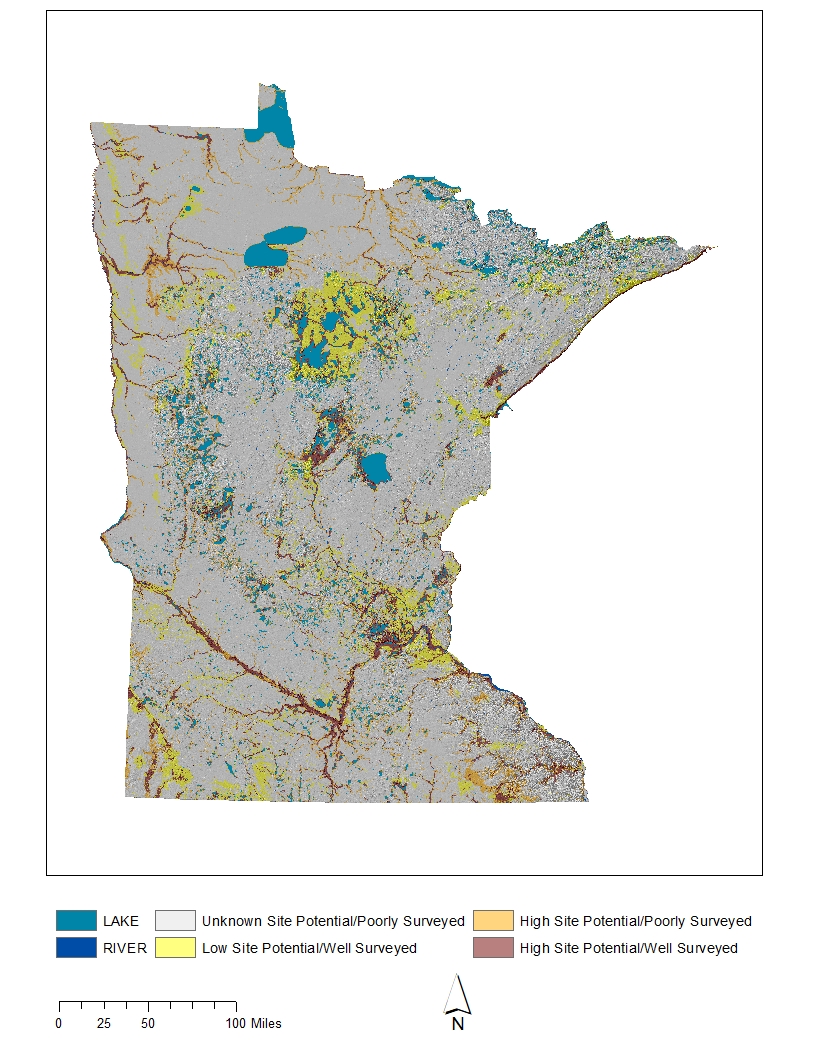
An archaeological predictive model is a tool that indicates the probability of encountering an archaeological site anywhere within a landscape. These are sometimes referred to as archaeological sensitivity maps because they indicate that some locations are more sensitive than others for cultural resources. These predictive maps usually contain three zones: a high sensitivity area where archaeological sites are most likely, a medium sensitivity area where sites are less likely, and a low sensitivity area where sites are unlikely. These maps are beneficial for transportation and land-use planning. If construction projects can be modified to avoid areas where archaeological sites are predicted to occur, the result is more cost effective planning.
The dependability of these models is a function of their performance. This can be examined and tested by comparing a predictive model to archaeological field survey results. By comparing known archaeological site locations to the model's predictions , it is possible to determine, with specifiable confidence, how accurately a model performs. It is, in fact, this very approach that gives us confidence in a model and allows us to use it as a predictive tool. Field testing a model is an essential component of demonstrating its reliability.
For a more complete discussion of this topic, see Appendix A of the Mn/Model Research Design. A related, but more technical, discussion is found in Appendix B, Modeling Theory and Assumptions.

Acknowledgements
Mn/Model was financed by the Minnesota Department of Transportation using funds set aside by the Federal Highway Administration's Intermodal Surface Transportation Efficiency Act.
Copyright Notice
The Mn/Model process and the predictive models it produced are copyrighted by the Minnesota Department of Transportation (MnDOT), 2000. They may not be used without MnDOT's Consent.

