
MWRRI Phase 7
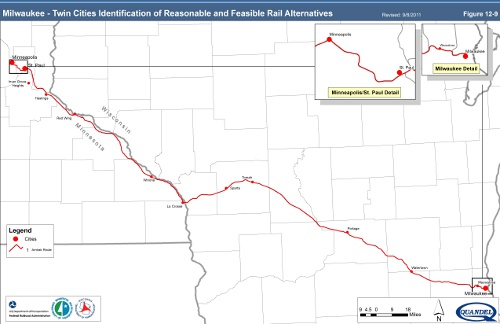
The Federal Railroad Administration has approved the release of the Final Alternatives Selection Report, which describes the methodology and analysis that was conducted to identify "reasonable and feasible passenger rail alternative(s)." The report identifies one route (Route 1, the existing Amtrak route from Milwaukee-Watertown-Portage-Tomah-La Crosse-Winona-Hastings-St. Paul-Minneapolis) as the most reasonable and feasible passenger rail alternative. The route provides an opportunity to incrementally use a reduction in travel time and increase train frequency by phasing the build-out of the route, according to the report. This phased approach recognizes the constraints associated with funding requirements for major infrastructure improvements and is consistent with the Minnesota Statewide Rail Plan.
- Final Alternatives Selection Report - Executive Summary (PDF 295 KB)
- Final Alternatives Selection Report (PDF 19.8 MB)
- Appendices:
- Appendix A - Interim Alternatives Selection Report: Identification of Potential Passenger Rail Alternatives (PDF 8.5 MB)
- Appendix B - Purpose and Need Statement (PDF 2.6 MB)
- Appendix C - Alternatives Analysis Methodology (PDF 1.5 MB)
- Appendix D - Engineering Assessment by Sub-Segment (PDF 10.0 MB)
- Appendix D - Engineering Assessment by Route (PDF 10.7 MB)
- Appendix E - Cost Estimating Methodology (PDF 2.5 MB)
- Appendix F - Number of Main Tracks (PDF 2.1 MB)
- Appendix G - Degree of Curvature (PDF 804 KB)
- Appendix H - Significant Grades (PDF 2.6 MB)
- Appendix I - Travel Time (PDF 3.2 MB)
- Appendix J - Population Bands (PDF 5.0 MB)
- Appendix K - Milwaukee to Madison 2009 High-Speed Intercity Passenger Rail
Program Track 2 Application (PDF 468 KB) - Appendix L - Capital Costs Spreadsheet (PDF 602 KB)
- Appendix M -Model for Annual Cyclic Capial Costs (PDF 332 KB)
- Appendix N - Freight Density Graphs (PDF 1.3 MB)
- Appendix O - Environmental Features Strip Map (PDF 335 MB - large file size)
- Appendix P - Letter from Wisconsin Department of Transportation to Commissioner of Minnesota Department of Transportation dated 8/31/2011 (PDF 23 KB)
- Draft Public Involvement Plan (PDF 724 KB)