
Environmental process | Environmental review | Greenhouse Gas Analysis for MEPA
Greenhouse Gas Analysis Process for MEPA
- Greenhouse Gas Analysis Standard Attachment (Word)
- Minnesota Infrastructure Carbon Estimator 3.0 (MICE 3) tool (Excel)
- MICE 3 User Guide (PDF)
- MICE 3.0 Training Slides (PowerPoint)
- MICE 3.0 Training Video (MP4)
- Minnesota Carbon Emissions Tool (CET) (Excel)
- Minnesota CET Instructions and Tips (PDF)
For any questions regarding the Greenhouse Gas (GHG) Analyses process, please email MICEanalyses.DOT@state.mn.us or contact the MnDOT GHG Specialist Daniel Saunders at daniel.saunders@state.mn.us. For further questions regarding the Carbon Emissions Tool (CET) and a vehicle operations analysis, contact Maurice Roers with the Office of Sustainability and Public Health at maurice.roers@state.mn.us.
Email your final Greenhouse Gas Analysis to MICEanalyses.DOT@state.mn.us.
Background
Minnesota’s position near the center of North America subjects us to an exceptional variety of extreme weather. During the course of a single year, most Minnesotans will experience both blizzards and heatwaves, windstorms, strong thunderstorms, and heavy rains.
In 2007, the state passed the bi-partisan Next Generation Energy Act that established goals for the state to reduce GHG emissions by 15% below 2005 levels by 2015, 30% by 2025, and 80% by 2050. However, the state did not meet our 2015 or 2025 goal and we are not on track to meet our future goals. The 2022 update to the Minnesota Statewide Multimodal Transportation Plan applied the Next Generation Energy Act goal to the transportation sector and set a target to reduce per capita vehicle miles traveled (VMT) by 20% by 2050.
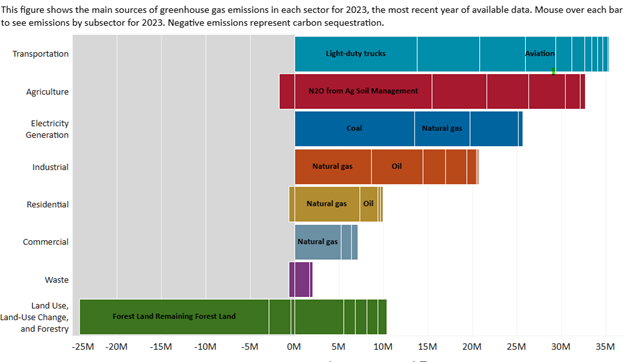
The most recent GHG emissions inventory from the Minnesota Pollution Control Agency (MPCA) showed that transportation overtook the electricity generation sector as the number one source of GHG emissions in Minnesota in 2016. This data is consistent with trends in other states, and changes in both sectors and trends (electricity is decreasing, transportation is increasing) are expected to continue in the future. Emissions from electricity generation have decreased 50 percent between 2005 and 2023, largely due to the reduced use of coal and increased use of renewable energy and natural gas, which are more cost effective and have lower carbon emissions. Transportation emissions decreased nine percent from 2005 to 2023, due to federal fuel efficiency standards. However, the market trends towards purchasing larger vehicles and more miles traveled have prevented reductions that are more significant. See the following figure for more information.
In 2019, MnDOT worked with other state agencies to explore ways to reduce GHG emissions from the transportation sector. This process resulted in the Pathways report, which contains a number of actions that MnDOT committed to take and recommendations for other state agencies and the Governor to consider. MnDOT committed to analyze GHG emissions from transportation projects as part of the environmental review process starting on January 7th, 2020.
Threshold criteria
This guidance applies a tiered approach that focuses on evaluation of the projects that have the greatest potential GHG emissions and does the following:
- Bases the level and type of analysis (qualitative/quantitative) on the data available, as determined by the environmental documentation (e.g., there is more data available for projects with a required quantitative mobile source air toxics (MSAT) analysis)
- Applies more effort on projects with a greater potential for substantial GHG emissions
Follow this guidance for projects on MnDOT facilities that require a state Minnesota Environmental Protection Act (MEPA) Environmental Assessment Worksheet (EAW) or Environmental Impact Statement (EIS).
The FHWA does not currently have any requirements for GHG or climate impact analysis for highway projects. No GHG Analysis should be included in any federal documentation.
Detailed requirements
MnDOT evaluates operational and construction/maintenance GHG emissions. The Minnesota Environmental Quality Board (MN EQB) and MEPA require a vehicle operations analysis when an EIS or EAW is determined to be needed.
Construction and maintenance emissions analysis
MnDOT requires estimates for construction and maintenance GHG emissions using the Minnesota Infrastructure Carbon Estimator (MICE) tool for the preferred alternative on each project. The MICE User Guide contains detailed instructions for using the tool. GHG’s for construction and maintenance are expressed in terms of Carbon Dioxide Equivalent (CO2e). This unit metric combines the climate effects of various GHG’s as if they were all CO2. MOVES and MICE both report operational emissions in units of CO2e.
Examples of project construction elements that MICE3 covers are:
- Bridges and overpasses (new construction or reconstruction)
- Bus rapid transit
- Culverts and storm sewers
- Land Use
- Light and heavy rail
- Lighting
- Parking
- Pathways (trails and sidewalks)
- Roadways
- Roadway Resurfacing and Reconstruction
- Signage
- Interchanges
- Noise Walls
- Roundabouts
- Traffic Signals
Examples of project construction elements that MICE3 does not cover are:
- Bridge maintenance and repair activities
- Fencing
- Guardrails and cable barriers
- Landscaping
- Pavement overlay projects (e.g., chip seal)
- Projects under negotiated maintenance contracts
- WIM and other truck monitoring infrastructure
All MICE results (what you report in the environmental document) should be emailed to MICEAnalyses.DOT@state.mn.us when complete. Include the State Project number, roadway (IE TH 65), month and year of letting, and the city where the project is located or nearby. A copy of the MICE run(s) should be included within the project file, but not within the federal documentation.
Considerations for construction emissions environmental document preparation
Refer to the MICE user guide when performing a construction emissions analysis. Email any project specific questions and GHG construction analysis documentation to MICEanalyses.DOT@state.mn.us.
Because other sources of information on emissions from the transportation network are readily available, there is no need to conduct a project-specific cumulative GHG emissions analysis for the cumulative effects discussion in an EIS. The MPCA prepares a GHG emissions inventory for the entire transportation sector in Minnesota every odd-numbered year. You can reference the most recent on-road vehicle portion of the inventory for comparison to operational GHG emissions from a single project. Depending on project location, the local metropolitan planning organization (MPO) may have a more refined local inventory with future emissions projections that includes the emissions from the proposed project along with all other planned projects in the area. MnDOT’s annual Sustainability Reports also include information on MnDOT’s progress meeting GHG emissions targets. You can use any of this information for a GHG discussion without conducting project-specific cumulative effects analysis. Use (and customize if necessary) the following language in the GHG section of the state EAW or EIS:
Minnesota’s position near the center of North America subjects us to an exceptional variety of extreme weather. During the course of a single year, most Minnesotans will experience both blizzards and heatwaves, windstorms, strong thunderstorms, and heavy rains.
The conditions, however, have changed rapidly, and an overwhelming base of scientific evidence projects that Minnesota’s climate will see additional significant changes through the end of the 21st century. Over the last several decades, the state has experienced substantial warming during winter and at night, with increased precipitation throughout the year, often from larger and more frequent heavy rainfall events. These changes alone have damaged buildings and infrastructure, limited recreational opportunities, altered our growing seasons, impacted natural resources, and affected the conditions of lakes, rivers, wetlands, and our groundwater aquifers that provide water for drinking and irrigation. The years and decades ahead in Minnesota will bring even warmer winters and nights, and even larger rainfalls, in addition to other climatic changes not yet experienced in the state.
In the years and decades ahead, winter warming and increased extreme rainfall will continue to be Minnesota’s two leading symptoms of climate change. Climate models used in the 2017 National Climate Assessment also project that Minnesota will have a greater tendency toward extreme heat, especially by the middle of the 21st century. The future drought situation in Minnesota is less clear and appears to depend on how much greenhouse gas emissions increase by mid-century.
Greenhouse gases (GHGs) are gases that warm the atmosphere and surface of the planet. Human activity has been increasing the amount of GHGs in the atmosphere, leading to changes in the earth’s climate. The primary GHGs are carbon dioxide (CO2), nitrous oxide (N2O), methane, (CH4), sulfur hexafluoride (SF6), and two classes of compounds called hydrofluorocarbons (HFCs) and perfluorocarbons (PFCs).
The most recent GHG emissions inventory from the Minnesota Pollution Control Agency (MPCA) showed that transportation overtook the electricity generation sector to become the number one source of GHG emissions in Minnesota starting in 2016. This is consistent with trends in other states, and changes in both sectors and trends (electricity decreasing, transportation increasing) are expected to continue in the future.
Construction Emissions
MnDOT evaluates greenhouse gas (GHG) emissions from projects due to concerns about current and future impacts of climate change in Minnesota. GHGs from transportation (carbon dioxide, methane and nitrous oxide) contribute to warming of the atmosphere, which leads to effects in Minnesota that include increases in heavy precipitation, increased flooding, and more episodes of extreme heat. FHWA.
Because the project will not change traffic, operational greenhouse gas emissions are not expected to change. Construction greenhouse gas emissions will result from production and transportation of construction materials, and from fuel used in construction equipment.
Table 1. Construction Analysis Results
| Construction CO2e Emissions (Total over Construction Period) | CO2e, Metric Tons (total) |
|---|---|
| Build Alternative |
Use the following language to summarize the GHG discussion:
This document summarizes the GHG emissions associated with construction of the proposed project (and vehicle traffic associated with the project, if analyzed). It does not include an assessment of the potential climate effects of those emissions. In the case of GHGs and climate change, climate is driven by global cumulative changes of GHG concentrations in the atmosphere; the changes in emissions from one individual project are simply too small to justify calculation of resulting changes in temperature, sea level, precipitation, and other significant cumulative climate effects, however, estimation of emissions is still useful to the public and decision makers so that they can understand whether projects are contributing to progress in mitigating climate change.
Assessing GHG emissions from transportation projects is one of several strategies that MnDOT is pursuing to address the issue of climate change. Other strategies that MnDOT is pursuing include intermodal transportation, electric vehicle incentives and infrastructure, clean vehicle standards, and alternative fuels. The agency is also developing a process for evaluating flood risk to MnDOT bridges, large culverts, and pipes. Studying the performance of infrastructure under predicted extreme events will help MnDOT gain knowledge and better assess the impacts of climate changes to plan, design, build, and maintain assets for resilience. More information regarding MnDOT’s efforts to address climate change can be found at Sustainability at mndot.gov/sustainability.
Vehicle operations emissions analysis
The MN EQB requires a Vehicle Operations analysis when a project is deemed to increase the flow of traffic, most commonly in roadway expansion projects or grade separated interchange projects.
Use the CET to calculate any project vehicle operations analysis. The CET user guide provides detailed instructions on how to generate GHG estimates for Vehicle Operations Analysis. GHG’s for vehicle operations are expressed in terms of Carbon Dioxide Equivalent (CO2e). This unit metric combines the climate effects of various GHG’s as if they were all CO2.
Even though the No Action alternative normally does not include any construction, it may still result in some maintenance emissions (due to the need to maintain the existing roadway network in the project area). The MICE user guide explains how to estimate these emissions for No Action (where applicable) and Build alternatives.
Considerations for vehicle operations environmental document preparation
Refer to the CET user guide when performing a vehicle operations emissions analysis. Submit any project specific questions and GHG vehicle operations analysis documentation to MICEanalyses.DOT@state.mn.us, and or the MnDOT Office of Sustainability and Public Health.
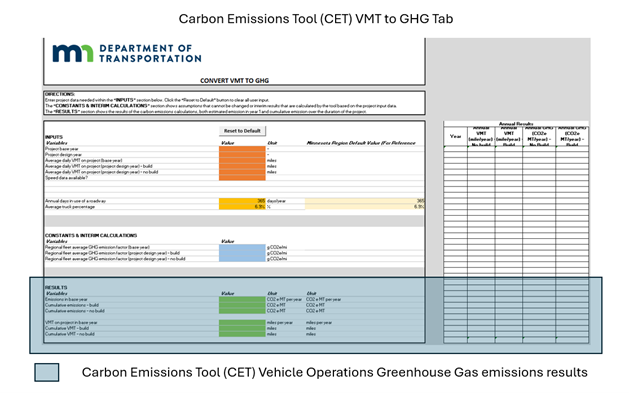
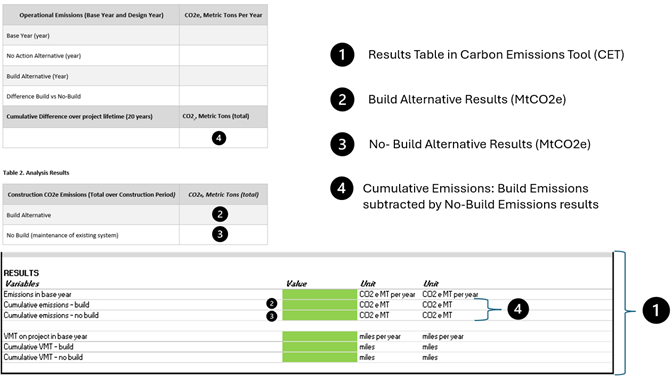
See Figure 1 for instructions on how to fill out the results table.
Because other sources of information on emissions from the transportation network are readily available, there is no need to conduct a project-specific cumulative GHG emissions analysis for the cumulative effects discussion in an EIS. The MPCA prepares a GHG emissions inventory for the entire transportation sector in Minnesota every odd-numbered year. You can reference the most recent on-road vehicle portion of the inventory for comparison to operational GHG emissions from a single project. Depending on project location, the local metropolitan planning organization (MPO) may have a more refined local inventory with future emissions projections that includes the emissions from the proposed project along with all other planned projects in the area. MnDOT’s annual Sustainability Reports also include information on MnDOT’s progress meeting GHG emissions targets. You can use any of this information for a GHG discussion without conducting project-specific cumulative effects analysis. Use (and customize if necessary) the following language in the GHG section of the state EAW or EIS:
Minnesota’s position near the center of North America subjects us to an exceptional variety of extreme weather. During the course of a single year, most Minnesotans will experience both blizzards and heatwaves, windstorms, strong thunderstorms, and heavy rains.
The conditions, however, have changed rapidly, and an overwhelming base of scientific evidence projects that Minnesota’s climate will see additional significant changes through the end of the 21st century. Over the last several decades, the state has experienced substantial warming during winter and at night, with increased precipitation throughout the year, often from larger and more frequent heavy rainfall events. These changes alone have damaged buildings and infrastructure, limited recreational opportunities, altered our growing seasons, impacted natural resources, and affected the conditions of lakes, rivers, wetlands, and our groundwater aquifers that provide water for drinking and irrigation. The years and decades ahead in Minnesota will bring even warmer winters and nights, and even larger rainfalls, in addition to other climatic changes not yet experienced in the state.
In the years and decades ahead, winter warming and increased extreme rainfall will continue to be Minnesota’s two leading symptoms of climate change. Climate models used in the 2017 National Climate Assessment also project that Minnesota will have a greater tendency toward extreme heat, especially by the middle of the 21st century. The future drought situation in Minnesota is less clear and appears to depend on how much greenhouse gas emissions increase by mid-century.
Greenhouse gases (GHGs) are gases that warm the atmosphere and surface of the planet. Human activity has been increasing the amount of GHGs in the atmosphere, leading to changes in the earth’s climate. The primary GHGs are carbon dioxide (CO2), nitrous oxide (N2O), methane, (CH4), sulfur hexafluoride (SF6), and two classes of compounds called hydrofluorocarbons (HFCs) and perfluorocarbons (PFCs).
The most recent GHG emissions inventory from the Minnesota Pollution Control Agency (MPCA) showed that transportation overtook the electricity generation sector to become the number one source of GHG emissions in Minnesota starting in 2016. This is consistent with trends in other states, and changes in both sectors and trends (electricity decreasing, transportation increasing) are expected to continue in the future.
Changes in traffic flow
MnDOT evaluates greenhouse gas (GHG) emissions from projects due to concerns about current and future impacts of climate change in Minnesota. GHGs from transportation (carbon dioxide, methane and nitrous oxide) contribute to warming of the atmosphere, which leads to effects in Minnesota that include increases in heavy precipitation, increased flooding, and more episodes of extreme heat.
The project is expected to [improve/degrade] traffic flow, which should reduce/increase operational greenhouse gas emissions. [Provide a very short explanation of how the project causes this effect on traffic flow, e.g., project reduces congestion, or project increases traffic volumes without a corresponding improvement in speeds, or project reduces design speed in order to improve safety, etc.] Construction greenhouse gas emissions will result from production and transportation of construction materials, and from fuel used in construction equipment.
Table 1. Operations Analysis Results
| Operational Emissions (Base Year and Design Year) | CO2e, Metric Tons per Year |
|---|---|
| Base Year (year) | |
| No Action Alternative (year) | |
| Build Alternative (year) | |
| Difference Build vs No-Build | |
| Cumulative Difference over project lifetime (20 years) | CO2e, Metric Tons (total) |
Table 2. Analysis Results
| Construcion CO2 Emissions (Total over Construction Period) | CO2e, Metric Tons (total) |
|---|---|
| Build Alternative | |
| No Build (maintenance of existing system) |
If the project was analyzed as a group of similar projects, state this and clarify that the results in the table are for the entire group.
Figure 1: Use the CET Results tables to fill in the EAW/EIS tables as shown below
Use the following language to summarize the GHG discussion:
This document summarizes the GHG emissions associated with construction of the proposed project (and vehicle traffic associated with the project, if analyzed). It does not include an assessment of the potential climate effects of those emissions. In the case of GHGs and climate change, climate is driven by global cumulative changes of GHG concentrations in the atmosphere; the changes in emissions from one individual project are simply too small to justify calculation of resulting changes in temperature, sea level, precipitation, and other significant cumulative climate effects, however, estimation of emissions is still useful to the public and decision makers so that they can understand whether projects are contributing to progress in mitigating climate change.
Assessing GHG emissions from transportation projects is one of several strategies that MnDOT is pursuing to address the issue of climate change. Other strategies that MnDOT is pursuing include intermodal transportation, electric vehicle incentives and infrastructure, clean vehicle standards, and alternative fuels. The agency is also developing a process for evaluating flood risk to MnDOT bridges, large culverts, and pipes. Studying the performance of infrastructure under predicted extreme events will help MnDOT gain knowledge and better assess the impacts of climate changes to plan, design, build, and maintain assets for resilience. More information regarding MnDOT’s efforts to address climate change can be found at Sustainability at mndot.gov/sustainability.
Mitigation
MnDOT has identified several practices that can help reduce emissions from projects. These practices directly reduce emissions through decreased fuel use, or indirectly through materials reuse (i.e. less processing and transport of new materials). When a project is in the project development phase, the plans are approximately 30% complete [note correct % if known], so your ability to use the listed mitigation practices may depend on further development. If the project is planning to include any of these practices, note them in the response:
The emissions reductions (per mile) for all of these practices has not yet been determined [or, insert estimated reductions calculated using the MICE tool]. That said, this project is planning to implement the following: [insert list of planned actions from the list below].
List of practices that may reduce emissions during a project:
- Full Depth Reclamation (FDR)
- Cold In-Place Recycling (CIR) and Cold Central Plant Recycling (CCPR)
- Warm-mix asphalt
- Recycled concrete aggregate
- Increase in overall wetlands, tree cover, or planted area
Agency involvement
The following external agencies are involved with GHG analysis:
- MPCA: The MPCA develops Minnesota GHG emissions inventories and can provide inputs for MOVES and GHG modeling
- MPO: Metropolitan Planning Organizations (MPOs) conduct regional traffic demand forecast modeling and can provide inputs for more accurate GHG accounting
Glossary
Carbon Dioxide Equivalent (CO2e): The emissions of multiple GHGs expressed in terms of their relative emissions if they were all carbon dioxide.
Minnesota Environmental Quality Board (MN EQB): The Minnesota Environmental Quality Board (EQB) is a state board that coordinates environmental policy and review among Minnesota agencies, oversees the environmental review process (EAW/EIS), and provides a public forum for environmental issues.
Greenhouse Gas (GHG): A gas that causes atmospheric warming. Transportation-related greenhouse gases include carbon dioxide, methane, nitrous oxide, and hydrofluorocarbons (air conditioning gases).
Metric Tons (MT): Common unit for reporting GHG emissions; a metric ton is 1,000 kilograms, or about 2200 US pounds.
Minnesota Infrastructure Carbon Estimator (MICE): Minnesota-specific version of FHWA’s Infrastructure Carbon Estimator
Motor Vehicle Emissions Simulator (MOVES): An EPA model for estimating GHG and other emissions from motor vehicles.
Mobile Source Air Toxics (MSAT): The 188 air toxics identified in the Clean Air Act, also known as hazardous air pollutants. FHWA has issued guidance and frequently asked questions for addressing MSATs in the NEPA process, and these FAQs are a helpful resource for analyzing GHG emissions with the MOVES emissions model, if that approach is used.
Minnesota Pollution Control Agency (MPCA): The agency that administers and enforces all federal and state laws relating to air pollution in Minnesota.
Metropolitan Planning Organization (MPO): The forum for cooperative decision making and the organization designated, together with the state, as being responsible for conducting the continuing, cooperative, and comprehensive planning process under 23 U.S.C. 134 and 49 U.S.C. 5303.
Minnesota Environmental Policy Act (MEPA): The Minnesota Environmental Policy Act is a state law enacted in 1973 that establishes Minnesota’s environmental review process for projects that may significantly affect the environment. The act aims to:
- Ensure environmental considerations are integrated into decision-making for major governmental actions and certain private projects.
- Require environmental review documents, such as:
- Environmental Assessment Worksheet (EAW) – a shorter review to determine if a full study is needed.
- Environmental Impact Statement (EIS) – a detailed analysis of potential environmental effects and alternatives.
- Prevent state actions that cause pollution, impairment, or destruction of natural resources when there is a feasible and prudent alternative.
- Promote public involvement and transparency in environmental decisions.
National Environmental Policy Act (NEPA): Environmental policy law:
Title I of NEPA contains a Declaration of National Environmental Policy. This policy requires the federal government to use all practicable means to create and maintain conditions under which man and nature can exist in productive harmony.
Section 102 in Title I of the Act requires federal agencies to incorporate environmental considerations in their planning and decision-making through a systematic interdisciplinary approach. Specifically, all federal agencies are to prepare detailed statements assessing the environmental impact of and alternatives to major federal actions significantly affecting the environment. These statements are referred to as Environmental Impact Statements (EIS) and Environmental Assessments (EA).
Title II of NEPA established the President’s CEQ to oversee NEPA implementation. The duties of CEQ include:
- Ensuring that federal agencies meet their obligations under NEPA
- Overseeing federal agency implementation of the environmental impact assessment process
- Issuing regulations and other guidance to federal agencies regarding NEPA compliance