

High-speed rail
What is high-speed rail?
High-Speed Rail service has the characteristics of conventional passenger rail service but at substantially higher speeds. HSR is most applicable in markets where the combination of travel demand and distance justifies the higher investment cost.
Operations place an emphasis on significantly improved average end-to-end speeds along a corridor, often with limited stops, offering travel advantages to auto and air travelers. North American practice defines HSR as being at least 110 mph. Operations can occur over track shared with slower passenger and freight trains at speeds of up to 150 mph, and on dedicated track where speeds in some countries now exceed 200 mph.
Amtrak’s Northeast Corridor Acela service is the only (partial) operational example of HSR in North America.
United States vision
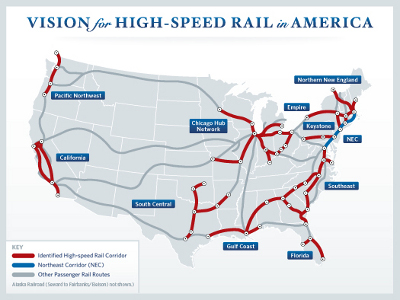
In April 2009, President Obama released his vision for high-speed rail in the United States. The plan identified $8 billion provided in the American Recovery and Reinvestment Act of 2009 and $1 billion a year for five years to develop a passenger rail system in the United States. Vsit the Federal Railroad Administration website for more information.
Midwest Regional Rail Initiative
Minnesota is a member of the The Midwest Regional Rail Initiative - a cooperative, multi-agency effort to develop a nine-state, 3000 mile regional passenger rail system. Read more about MWRRI.