
Staged construction on cooperative agreement bridge projects: hazards and mitigation strategies
By: Dave Conkel, State Aid Bridge Engineer
This document serves as a State Aid advisement to help incorporate these lessons into project development and improve safety outcomes for workers and roadway users.
Cooperative Agreement projects often involve local roadways crossing over interstates or state highways. For local routes over waterways, which make up a large percentage of local bridge projects, this guidance continues to apply to many of the hazards and mitigation items listed in this advisory.
Staged construction on city and county transportation projects often forces bridge and roadway work into tight, constrained spaces directly adjacent to live traffic. Many local routes have limited width, fewer detour opportunities, and restricted options for lane closures. These conditions elevate risk for construction crews, motorists, and the project itself.
The MnDOT Bridge Office has compiled extensive observations of hazards that frequently arise during staged bridge construction. This article organizes those findings into a clear reference for State Aid delivery personnel, supported by example photos. These insights are intended to help local agencies and consultants anticipate risks earlier, plan more realistic staging, and ensure safe and efficient project execution.
Why local staged construction is high risk
City and county projects face unique constraints:
- Narrow roadway widths
- Businesses, utilities and driveways limit detours or full closures
- Crews must work near or over live traffic
- Limited flexibility for traffic switches, staging changes or extended closures
With these limitations, many activities occur directly on or next to open lanes. The following sections highlight common hazards and mitigation guidance.
1. Bridge pier struts or infill walls
Hazard:
- Open excavation near traffic. Typically this excavation does not use steel sheeting because it is under an existing bridge. Open cut excavation will potentially undermine pavement, create a hazard of a working pit where workers may be trapped if errant traffic veers into excavation.
Mitigation:
- Barrier for separating traffic from excavation is desired
2. Expansion joint installation near live traffic
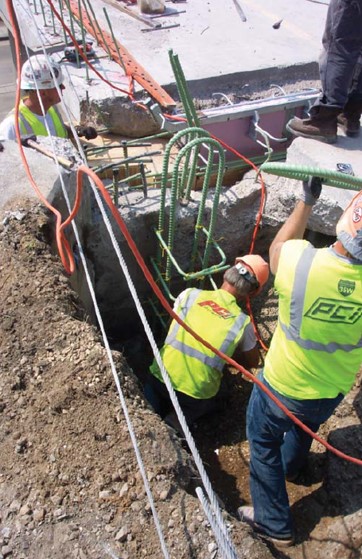
Hazards:
- Tight workspace for welding
- Open slab conditions adjacent to traffic
- Tools and materials near travel lanes
- High risk of intrusion from inattentive drivers
- Potential rework if an unprotected drop is struck after hours
Mitigation:
- Provide buffer lanes (minimum 10 ft. when possible)
- Use portable precast barrier for stronger separation
- Consider full closures for Stage-2 joint welding
- Avoid performing joint installation under short nighttime windows unless durations are adequate
3. Excavation for approach panels and joint areas
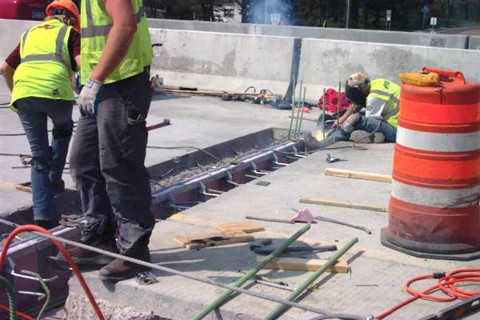
Hazards:
- Vehicle intrusion into the excavation
- Drop-off leading to damage or crash risk
- Worker exposure in confined spaces next to traffic
- Potential rework if an unprotected drop is struck after hours
Mitigation:
- Portable barrier between excavation and traffic
- Buffer lanes whenever feasible
- Consider off‑peak work windows
- Ensure pavement repair quantities include old footing removal zones
4. Structural excavation below deck edge
Hazards:
- Confined pits where workers operate close to moving vehicles
- Skewed bridges produce irregular staging geometry
- Rebar cages, equipment and forms protruding into limited workspace
- Increased difficulty ensuring safe egress routes
Mitigation:
- Anchored or unanchored barriers for physical separation
- Plan buffer lanes into the Temporary Traffic Control (TTC)
- Adjust staging for skew, available workspace and formwork footprint
5. Under-deck forming and overhang bracket installation
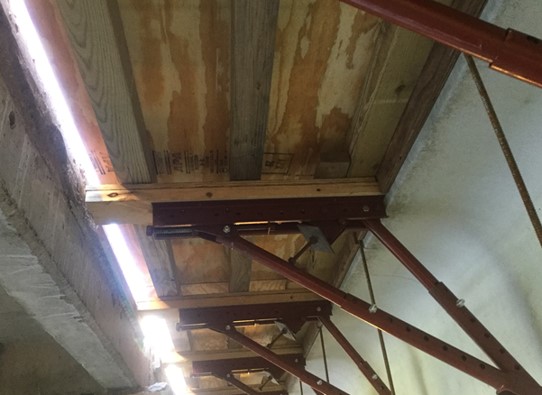
Photo of Bridge 38018 where bridge construction
was staged. During removals they would be
chipping next to traffic and use plywood protection
board behind the barrier. Joining the 2nd stage deck
was complicated by the fact that beam camber in
those beams was up while the cast deck was down,
creating difficulty with rebar laps and slab placement
since the tied mat was being held up by the hardened
deck during pour.
Hazards:
- Falling tools, plywood or debris
- Skewed forming does not align with neat traffic control lines
- Narrow spacing between forming and vehicles
- Night work and potential for reckless driving
Mitigation:
- Buffer lanes specifically for under-deck activities
- Account for skew in TTC development
- Provide additional time for wide bridges (>80 ft.) where forming or removal is slow
- Avoid over reliance on nighttime windows that may be too short for safe completion
6. Bridge deck repairs and removal
Hazards:
- Chipping operations near traffic
- Full-depth repairs close to staging joints
- Steel girders bounce when deck removal occurs, shedding underside concrete
Mitigation:
- Avoid staged full-depth repairs when possible
- Detour traffic during deck removals on continuous steel girders
- Pre-inspection and removal of loose underside concrete if adjacent spans must stay open
- For bridge deck removals on prestressed concrete beams, restrict traffic under adjacent spans so that removal equipment is never over traffic and has a lane buffer
7. Bridge deck concrete placement
Hazards:
- Falling concrete, tools, water, cement and curing compounds may reach live traffic
- Placing concrete over live traffic requires a secondary catchment system, increasing forming and removal time
- Bridge deck overhangs cannot support catchment systems, creating unavoidable drop hazards
- Wide decks progress slowly and may not fit within short nighttime closure windows
- Weather, setup time and shutdown time add uncertainty
- Skewed bridges and poured end diaphragms increase forming time
Mitigation:
- Continue routing traffic away from placement areas
- Estimate placement duration using a rate of seventy cubic yards per hour
- Allow flexibility for wide decks, weather delays and skewed forming
- Coordinate placement timing with traffic control to ensure safe completion
8. Deck form removal
Hazards:
- Same drop hazards as installation
- Tools and formwork removed near lane lines
- Night removal increases visibility problems
Mitigation:
- Buffer lanes
- Additional closure time for wide bridges
- Account for skew and forming geometry
9. Beam and girder setting
Hazards:
- Transport requires careful maneuvering on constrained surfaces
- Beam stability issues during rigging and lifting
Mitigation
- Develop realistic erection-time guidance with industry
- Directional closures recommended for spans with >6 beams
- Provide adequate TTC for safe beam transport and placement
10. Bridge steel painting and concrete coating
Hazards:
- Tarps billowing from traffic wind gusts
- Drips or overspray contacting vehicles
- Difficult to stage when no pier or median separates work areas
Mitigation:
- Full closures where staging cannot safely isolate work areas
- Use trailers or shorter tarp systems to reduce wind effect
- Directional closures work if there is a substructure or median dividing work areas
11. Overhead sign installation
Hazards:
- Sign structures swing over re-routed lanes
- Traffic may be present beneath lifting operations
Mitigation:
- Traffic rerouting should be planned during sign erection
- Include this activity explicitly in staging sheets and Traffic Management Plan (TMP)
12. Traffic switches and crossovers
Hazards:
- Contracts may lack redundant barrier for crossover transitions
- Temporary geometry may place traffic too close to staging lines
Mitigation:
- Always provide sufficient portable barrier during transitions
- Do not overlook crossover needs during design review
13. Old bridge footing removal
Hazards:
- Pavement reconstruction plans may not account for footing removal
- Excavations can conflict with traffic control after new bridge opens
Mitigation:
- Include footing removal in TMP
14. E5 / E8 joint installation at 28 days minimum age concrete
Hazards:
- Workers crouched next to live traffic during installation
- Typical installation takes less than a day but requires safe work space
Mitigation:
- Allow 8-hour closure windows
- Provide buffer lanes
- Use precast barrier when full closures are not feasible
15. Concrete pavement rehabilitation with adjacent traffic
Hazards:
- Workers operate close to live traffic even though repairs are shallow
- Vehicles may pass close to the repair area with limited reaction time
- Tools, materials or debris may shift toward open lanes
Mitigation:
- Barrels or precast concrete barriers provide appropriate separation for this low-risk work
- Requiring precast concrete barrier for all work may reduce productivity without significant benefit.
- Provide a buffer lane behind barrels when possible
- Schedule rehabilitation during lower-traffic periods to reduce risk
Conclusion
Staged construction on local roadways requires heightened awareness, careful planning and thorough coordination among designers, inspectors and contractors. The inclusion of hazards and mitigation guidance for cooperative agreement projects and local routes over waterways helps ensure safer design and execution. By applying these lessons during project development, safety outcomes improve for both workers and roadway users.