
Allied Radio Matrix for Emergency Response - ARMER
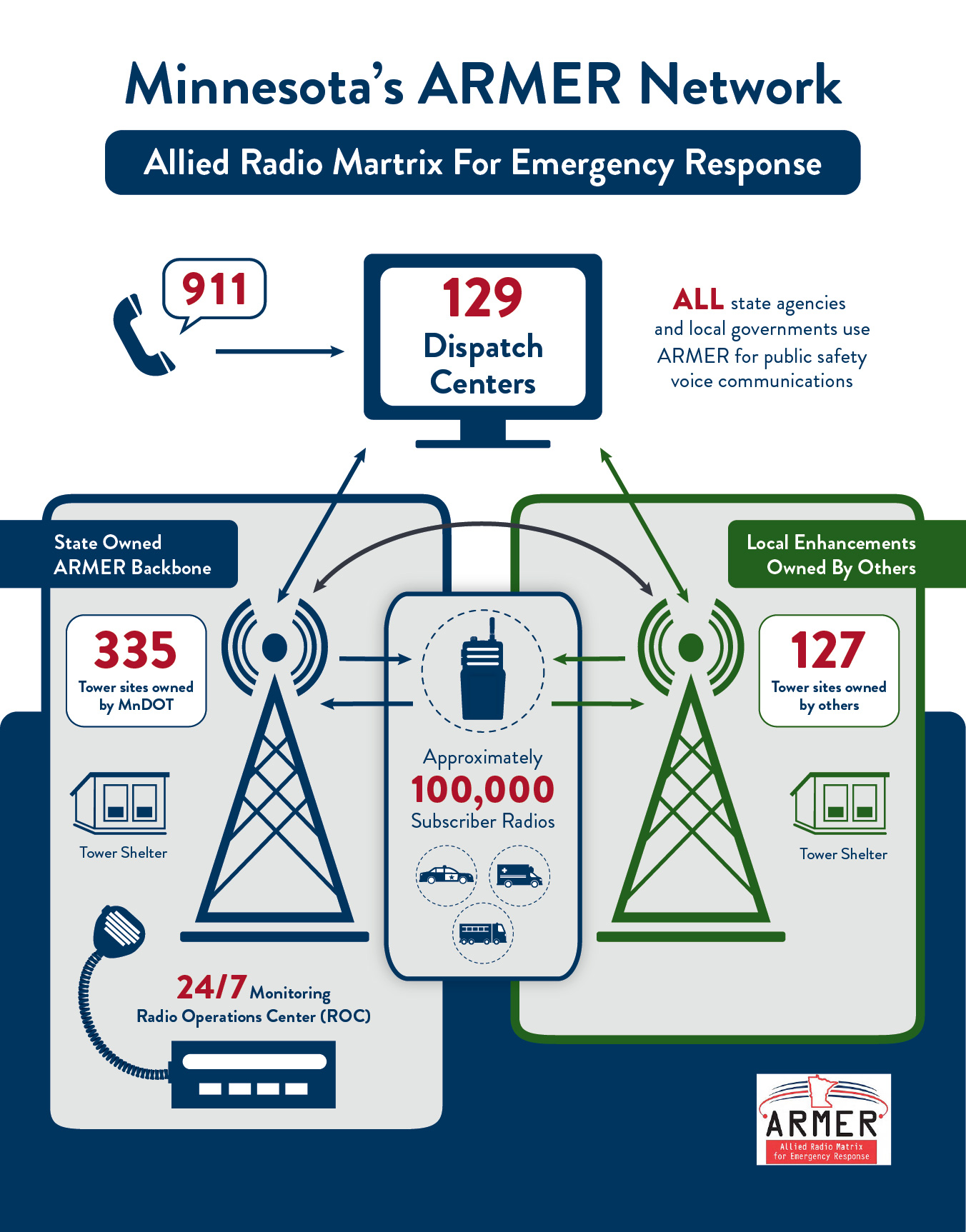
MnDOT owns, builds, operates and maintains ARMER backbone - Minnesota’s shared public safety radio communication system.
The system backbone is a network of radio towers, equipment shelters and radio transmission equipment. This trunked backbone is shared by network users throughout the state, as identified in the statewide radio communication plan maintained by the Statewide Radio Board.
The ARMER backbone is used by MnDOT, the State Patrol, the Department of Natural Resources, and other state agencies for voice and data communications. The backbone is shared with local governments and other emergency response organizations so that all emergency responders can have interoperable communications with each other.
The ARMER system covers nearly all of Minnesota, working day and night to make sure that the state’s emergency responders can communicate in the best and worst of times.
The Allied Radio Matrix for Emergency Response (ARMER) system currently serves as the critical primary communications tool for most public safety personnel in Minnesota. It’s a trunked (linked) network of radio towers, equipment shelters and radio transmission equipment that allows users to have seamless, uninterrupted, interoperable communications with each other.
In other words, it allows different organizations to be on the same channel.
Prior to ARMER, agencies used legacy radio networks that didn’t allow for seamless communication. Responding organizations often couldn’t access one another’s frequencies, leaving command staff and emergency operations centers unable to monitor incidents unless they were nearby.
This project is a major partnership. All state agencies and local governments use ARMER for public safety voice communications. The Department of Public Safety administers the system and MnDOT owns, builds, operates and maintains the technological backbone that makes it possible.
While a radio can transmit at the push of a button, a lot of things must be working behind the scenes for that button to function.
ARMER is made possible thanks to 335 radio towers across the state, excluding the Boundary Waters. Each tower site is about 15-20 miles apart from another, with more than 125 “local enhancement sites,” where cities, counties or other entities have added radio transmission equipment on stand-alone towers, buildings or water towers.
The average tower is around 330 feet tall. They are looped together by microwave dishes which serve as relay stations, passing along messages as far as they need to go. Unlike a cellphone, there are very few spots with no coverage.
These towers work in concert with a set of “master sites,” which are at or near MnDOT truck stations. These master sites include enhanced shelters for onsite radio equipment, with HVAC systems for keeping the equipment cool during the hot summer months. In winter, the buildings use cold winter air to do the same job. Propane-powered backup generators at the sites keep the communication site functioning if the electric grid goes down.
The system must take anything that nature can dish out. It must work the same in 100-degree heat as it does when it’s 40 below zero. The towers need to stand tall in 120 mph wind and can thanks to drilled foundations that go down 60 feet. Each tower is strong enough to tolerate an inch of winter ice coating, severe high winds or direct lightning strikes.
If something does break, it’s up to MnDOT radio crews to fix it. Seventy staff members, based in 16 radio shops throughout the state, do preventative maintenance, installations and repairs on each site twice throughout the year. MnDOT radio crews can repair and maintain all of the HVAC, microwave, radio network systems, RF transmitters, tower lighting and backup power systems as well as climbing the tower to repair or replace antenna and lighting systems. Many of the radio towers in the ARMER network are in remote locations requiring special access requirements including 4wd trucks, snowplows, snowmobiles or even snowshoes.
A statewide radio network offers a level of reliability and redundancy that cellphones can’t. It also gets everyone on an interoperable (i.e. able to work together) communications network.
The opening of the 21st century highlighted the need for communications that work across agencies. During the Sept. 11 terror attacks in 2001, radio communications barriers prevented all agencies from being able to talk to each other. Since then, unified systems like ARMER have sprouted up across the country.
ARMER was first built in the Twin Cities in 2004, then moved to St. Cloud and Rochester and has since migrated throughout the rest of Minnesota. It’s been used during major, multi-agency response events, like the 2007 I-35W bridge collapse, the 2018 Super Bowl, and during the 2020 unrest in Minneapolis. Small, localized responses are also used for fires or events (like parades or marathons).
For events, a communication plan is usually developed as the communications roadmap all responding agencies will follow. Organizers assign each individual role or team to a “talkgroup.”
Talkgroups (channels) are programmed into the radio units that each responder uses. For example, on a large fire, talkgroups will be assigned for staging, interior attack, water supply, Rapid Intervention Team (RIT Team) and more. The communication plan isolates radio traffic for a specific purpose or mission and avoids excessive, unnecessary conflicting radio traffic.
Coordination, training and exercises prepare responders to efficiently use the system. Attempts at a simultaneous transmission result in an alert tone to the user, and users are trained in how to manage such incidents.
Dispatch centers, command vehicles and emergency operations centers all have access to these talkgroups, enabling them to direct or support an operation from anywhere in the state. For instance, a major incident in northern Minnesota could be monitored and supported by the State Emergency Operations Center (SEOC) located in Blaine.
Emergency operations centers (EOC) use the communications plan to support the incident by monitoring and directing resources.
ARMER is used by nearly every public safety responder in the state. Training and coordination ensure an efficient, well-managed communications system.
MnDOT works in partnership with the Department of Public Safety and the Statewide Emergency Communications Board and Committees on the ARMER system. See the SECB website for information about the statewide network, standards, reports, committee meetings and background.
Cities, counties, and other public safety/governmental agencies can request to use space on the MnDOT towers and shelters where there is excess capacity. Other wireless users (non-public safety and private) may also request to use capacity on MnDOT towers where the capacity is not required for public safety users. All requests must be submitted to MnDOT for review and approval. To request a user request form or if you have questions about collocating on MnDOT communication towers, please contact the following:
- Statewide Radio Communications contract specialists
- Alice Robbins
612-590-9671 - Jackie Brown
651-418-1590