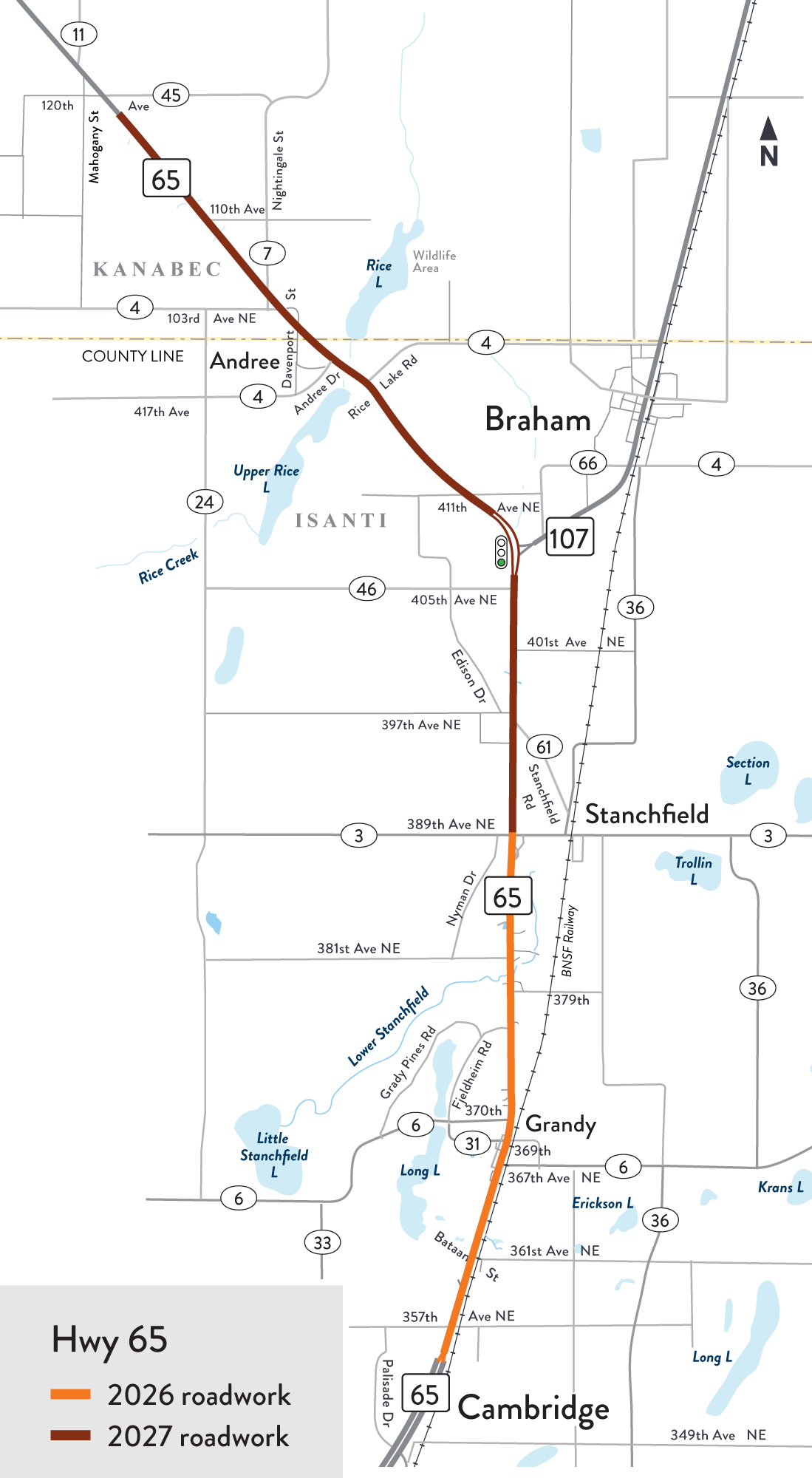
Thank you for your patience during the 2026 construction season. Crews will return in spring 2027 to finish the Hwy 65 project between Braham and Brunswick. With all drainage work complete, construction can focus on finishing the road surface.
Periodic lane or shoulder closures may occur year-round on this project.
About this roadwork project
MnDOT will resurface and update over 10 miles of Hwy 65 from south of 357th Ave. NE at the end of four-lane in Cambridge to south of Kanabec Co. Rd. 45/120th Ave. north of Braham, includes drainage and sidewalks in Grandy.
Hwy 65 work Cambridge to north of Braham. Select PNG image to enlarge
Add northbound left turn lane on Hwy 65 at 357th Ave. NE north of Cambridge - complete
Replace culverts at multiple locations under Hwy 65 - complete
Update or repair guardrail
Add Hwy 65 intersection lighting at:
Isanti Co. Rd. 6 and Co. Rd. 4
Kanabec Co. Rd. 4 and Co. Rd. 16 (King Rd.)
Install centerline/shoulder mumble strips and paint new pavement marking
Make any other necessary repairs
Grandy - work complete
Resurface road
Replace underground storm sewer
Upgrade pedestrian sidewalks
Extend center left-turn lane
About cold-in-place recycle*
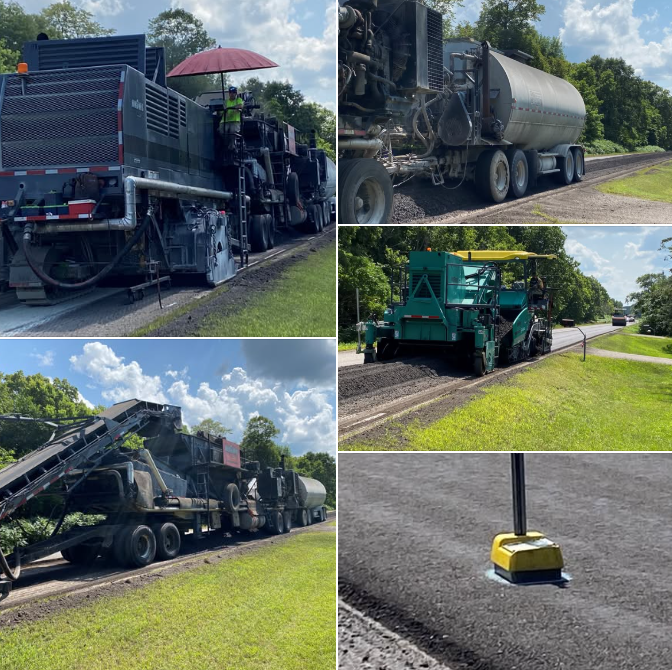
This road surface treatment and equipment is being used on this project. The process involves a convoy of equipment to finish a road surface, including tankers that hold emulsion material and water, milling or crushing and recycling machines, pavers and rollers.
Photos show how cold-in-place recycling works at the job site.
Mill and grind the old road surface with a grinding machine.
Materials are transferred onto a belt to another machine that adds cement and a liquid strengthener (tank). Materials are then placed back onto the road in a long, low ridge called a windrow.
A paver then picks up the windrow and spreads the material evenly across the width of the lane. Heavy rollers then compact the material.
Once the surface is flat, a density tester (yellow metal box) is used to ensure adequate compaction.